
Many parents research Cambridge schools in Lisbon and ask themselves: “Is this for us?” This guide from Astoria International School, a private school in Lisbon with an integrated Cambridge programme – answers the most practical questions.
Choosing a Cambridge school in Lisbon always raises the same questions: what changes day to day, and what distinguishes an officially accredited Cambridge School in Portugal from a school that simply calls itself an “English school” or “international school”.
It was precisely to answer those questions that Astoria International School, a private school in Lisbon with a Cambridge programme – put together this guide.
What the Cambridge curriculum is and why it is recognised in over 160 countries
The Cambridge Primary curriculum is developed by Cambridge University Press & Assessment. It is not an exclusively British curriculum, but an international benchmark that runs alongside each country’s national programme.
Its foundation is deep understanding and the application of knowledge to real-world situations, preparing pupils for university entry.
How the Cambridge Primary curriculum integrates with the Portuguese national programme
One of the questions parents ask most often when comparing Cambridge with national education is this: “Does the child miss out on any of the Portuguese programme by following this model?” The answer is no.
In Portugal, schools accredited by Cambridge International Education fully meet the requirements of the Ministry of Education and add the Cambridge component in parallel, enriching the national curriculum without replacing it.
At Astoria International School, this balance is built into the educational project from the very start: the national programme sits alongside Cambridge Primary in the 1st Cycle of Primary School and Cambridge Lower Secondary in the 2nd Cycle (Middle School), bringing both frameworks together seamlessly, without the child feeling any tension between the two systems.
What changes day to day: routines, materials, language of instruction
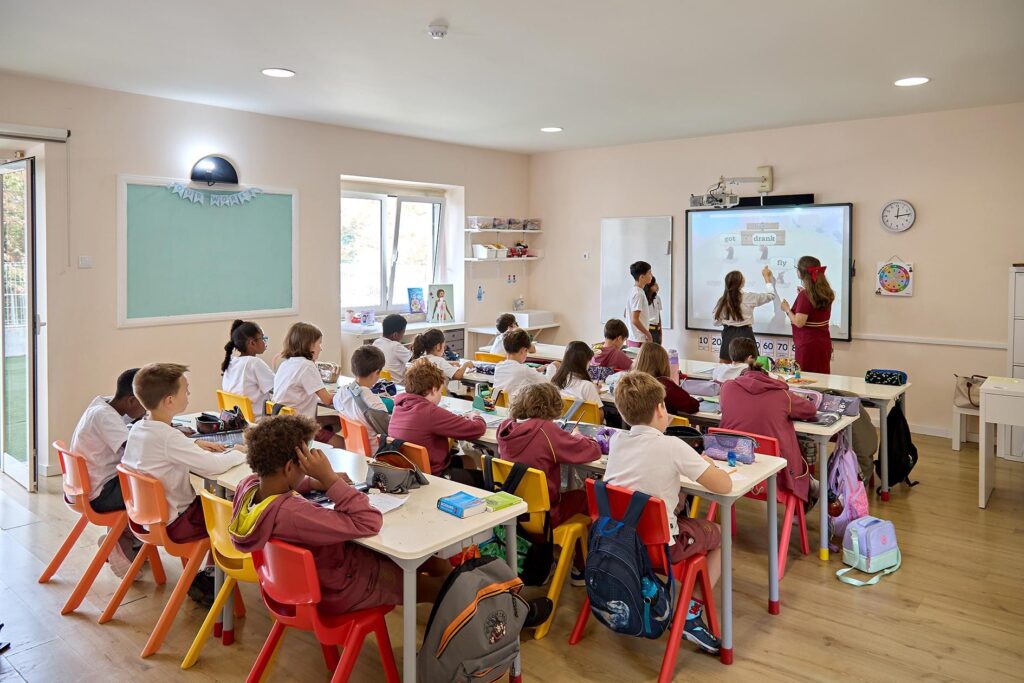
The most visible difference for a child is the language in which part of the lessons take place. Subjects such as science, written expression and mathematics are taught in English by native or highly proficient teachers, which means language acquisition happens through natural immersion.
Cambridge materials are designed specifically for children: they are visual, theme-based and oriented towards simple research projects. A typical morning in Primary School might include a short discussion in English about a science topic, followed by written work in Portuguese on the same subject.
The interplay between the two languages happens within the routine itself, without the child having to switch register artificially.
Cambridge English certifications for every age (Starters, Movers, Flyers, KET, PET)
One of the most concrete advantages of earning Cambridge certifications while still at school is their lifelong validity, as well as their global recognition.
Cambridge’s international assessments accompany each stage of the journey progressively, which means the child never sits an exam without being prepared for it.
At age 7: Starters
Cambridge English Starters (Pre-A1) is the first certification. It assesses basic reading, writing, listening and speaking skills through playful, visual tasks.
There is no pass or fail: each child receives a certificate with shields reflecting their performance, creating a positive experience around assessment from a very early age.
Ages 8 to 11: Movers and Flyers
Movers (A1) and Flyers (A2) progressively deepen the ability to communicate in everyday situations.
Flyers is equivalent to KET for Schools and prepares the child directly for the general-level exams, making the transition between certifications a natural progression rather than a demanding leap.
For ages 11 and over: KET, PET, FCE
From the 5th and 6th years onwards, pupils move on to the Key English Test (A2), the Preliminary English Test (B1) and the First Certificate in English (B2).
At Astoria, these certifications are woven into the Middle School journey organically, without requiring additional preparation outside school.
Skills developed: critical thinking, communication, autonomy
The Cambridge curriculum is explicitly designed to go beyond subjects. Throughout the journey, children learn to ask questions rigorously, to evaluate sources critically, to work in teams and to present their views clearly. These are skills that the job market and universities increasingly recognise and value.
At Astoria, these competencies are developed in line with Howard Gardner’s “Theory of Multiple Intelligences” and the principles of the Modern School Movement.
How it prepares the child for Secondary and Higher Education (Portugal and abroad)
A pupil with a Cambridge journey reaches Secondary Education with two clear advantages: they have a certified level of English and are used to a skills-based assessment model, which makes adapting to any European education system easier.
For families considering sending their children to study abroad, Cambridge certifications are often an admission requirement or a criterion for awarding scholarships at British, Dutch, German or Scandinavian universities.
Do parents need to speak English at home?
No. The Cambridge model is designed to work within the school. Language immersion happens in the school environment, with teachers and classmates, and that contact is enough for the child’s progressive, solid development.
What is asked of parents is involvement, not fluency: reading with their children, showing genuine interest in what they have learned and supporting preparation for the certification exams. None of this requires the family to master English. It is one of the most common misconceptions about the model — and one of the easiest to dispel.
The practical difference between “bilingual” and “official Cambridge curriculum”
Some schools call themselves “bilingual” and others hold Cambridge accreditation. The difference is substantial and worth understanding before making any decision.
A bilingual school can define its own curriculum in English without any external audit. An officially accredited Cambridge School in Portugal, such as Astoria International School, is subject to regular evaluation by Cambridge International Education, uses certified materials, and gives its pupils access to exams with international validity.
It is the difference between a label and a verifiable guarantee.
How much a Cambridge school in Lisbon costs
International schools in Lisbon generally range between €10,000 and €20,000 a year. At Astoria International School, the annual fee falls significantly below that range, with monthly fees starting at €575 for the Nursery, Daycare and Kindergarten, and €628 for the cycles of Basic Education.
Counting the annual fee, enrolment and standard meals, the estimated total cost per family is between €9,000 and €10,000 per school year, before any optional extracurricular activities.
For families researching the best nurseries in Lisbon with a bilingual component and international certification, this represents an entry into the Cambridge model from the very first months of life, with the methodology introduced through songs, games and free play from the Nursery onwards.
Considering everything included in the educational project, it is a genuinely competitive figure within the current landscape of English schools in Lisbon.
How to choose a Cambridge school in Lisbon: a checklist for parents
Knowing how to choose a nursery or a school with the Cambridge programme takes much more than reading the brochures. Before making a decision, it is worth checking the following points at each visit:
- Is the school listed as accredited on the Cambridge International Education website?
- Does Cambridge complement the national programme or partly replace it?
- Do the teachers have certified Cambridge training?
- Are the EYL certifications (Starters, Movers, Flyers) part of the journey, or charged separately?
- Does the school support the child from preschool to the 9th year, with no need to change institution?
- Does the educational project align with your family’s values?
- Have you visited the facilities and spoken with the pedagogical leadership?
The answers to these questions always reveal more than any brochure. To learn more about the educational philosophy and values that guide Astoria’s project, visit the “About Us” page.
In closing
To enrol your child at Astoria International School’s nursery in Lisbon, or in any other stage of study up to the end of Middle School, you can contact the admissions team (available throughout the year) and check availability.
The decision to place a child in a Cambridge school in Lisbon is rarely made in a single day: it is a choice that involves values, logistics and a clear vision of the kind of adult you want to help shape.
The Cambridge model is a concrete option for families who want to prepare their children for a world in which English, critical thinking and the ability to learn independently are increasingly decisive.
If you still have doubts, the best way to clear them up is to see the school from the inside. You can book a visit and meet the team, the facilities and the atmosphere that make Astoria a reference in private education in Lisbon, in person.
Frequently Asked Questions (FAQ)
1. Can my child join Astoria without speaking English?
Yes. The progressive immersion model is designed to welcome children with no prior knowledge of English, especially in the early years. Language acquisition happens gradually and is integrated into the routine, rather than being a prerequisite for entry.
2. Do Cambridge grades count towards Portuguese state education?
The national curriculum is delivered in full. Cambridge certifications for children and young people are an addition to the journey, with their own international recognition, and not an alternative to the Portuguese system.
3. How does enrolment at Astoria in Lisbon work?
Enrolment can take place throughout the year, subject to availability and in line with current legislation. The school welcomes children from four months old in the Nursery. We recommend contacting the admissions team in advance, as places tend to fill quickly.
4. Do Cambridge exams have an expiry date?
No. The Cambridge English: Young Learners certifications and the general-level exams, including KET, PET and FCE, are valid for life.
5. What sets Astoria apart from other Cambridge schools in Portugal?
Beyond its Cambridge accreditation, Astoria combines the international curriculum with a progressive multilingual model: from English-Portuguese bilingualism in the early years, to trilingualism with German from the 3rd year, and multilingualism with French from the 5th year. The journey is continuous from the Nursery to the end of Middle School, and the methodology draws on the “Theory of Multiple Intelligences” and the Modern School Movement.