Multilingual education in Lisbon is no longer a promise, it is a daily practice. At Astoria International School, Portuguese, English, German and French enter the curriculum progressively, from the age of 4 months, based on each child’s development.
Many parents wonder whether it is possible for a child to grow up with four languages without it being too much for them. It is a legitimate question that deserves an honest, well-grounded answer.
Multilingual education in Lisbon is no longer a distant promise — it has become a concrete reality in schools such as Astoria International School, which offers a continuous educational journey from the Nursery through to the end of Middle School.
What sets Astoria apart from many other bilingual schools in Lisbon is precisely the scale and intentionality of its approach: four languages (Portuguese, English, German and French) integrated into the curriculum in a progressive way, designed to support long-term language development rather than to overload.
In this article, we explain how this model works at our private school in Lisbon, what the science says about its benefits, and what the child learns at each stage of school life.
The critical window for language acquisition, from 0 to 7 years
A baby’s brain is not a miniature version of the adult brain, but an extraordinarily plastic structure, primed to absorb language patterns with an efficiency it will never have again.
Neuroscience identifies the first seven years of life as the period of greatest sensitivity for language acquisition. It is during this phase that the neural connections dedicated to phonetic, prosodic and semantic processing become established with greater ease and permanence.
Researcher Patricia Kuhl, of the University of Washington, demonstrated in her TED Talk “The Linguistic Genius of Babies” that babies are born as “citizens of the linguistic world”, able to distinguish the sounds of any human language.
Over time, the brain specialises in the patterns of the language it is most exposed to, and that window of maximum plasticity begins to narrow from around the age of seven. Although it never closes completely, the ease of acquisition decreases measurably.
This means that exposing a child to multiple languages before the age of 7 is not just a competitive advantage, it is also seizing the right neurological moment. Sounds, musicality and grammatical patterns are imprinted at a much deeper level when exposure happens early, which explains the undeniable value of multilingual education in the Nursery and Daycare years: these are stages in which the child absorbs languages the same way they absorb everything else – through lived experience, affection and repetition.
What is the difference between bilingual education, multilingual education and language immersion?
These terms are often used interchangeably, but they refer to distinct realities:
- Bilingual education: two languages are used as vehicles of instruction rather than as subjects. A child might learn Maths in English and Science in Portuguese, for example. The language is not the object of study, but the tool.
- Multilingual education: goes further, involving three or more languages integrated into the educational journey, with a progression designed so that each language consolidates before the next is introduced.
- Language immersion: the child is surrounded by an environment in which the foreign language is the main or only form of communication at certain times of the day. Nothing is translated or explained in the mother tongue: it is learned through context and need, just as the mother tongue was learned.
At Astoria International School, these three dimensions coexist in harmony. There are moments of genuine immersion in English, a multilingual progression with the gradual introduction of German and, later, French, and a bilingual logic that structures the educational routines from the very first months.
How a curriculum with four integrated languages works (PT/EN/DE/FR)
The key word in Astoria’s approach is “progression”. The model does not introduce four languages at once from day one; it does so gradually, respecting the stages of the child’s cognitive development:
- Nursery, Daycare, Kindergarten and the 1st and 2nd years of Primary School: bilingual education in Portuguese and English, the two languages that form the foundation of the journey.
- 3rd and 4th years of Primary School: German is introduced, moving to a trilingual model (PT/EN/DE).
- From the 5th year (Lower secondary and third cycle): French is added and all four languages are fully consolidated in academic contexts.
In daily life, the languages are distributed across activities, teachers and specific contexts. Each language has its functional “territory” within the school, which helps the child to internally organise their linguistic repertoire without confusion.
What the child learns at each stage
O percurso linguístico na Astoria evolui à medida que a criança cresce. Eis o que acontece em cada fase:
1. Nursery (4 months–2 years)
At this stage, language learning does not happen through formal instruction, but through sensory and emotional experiences.
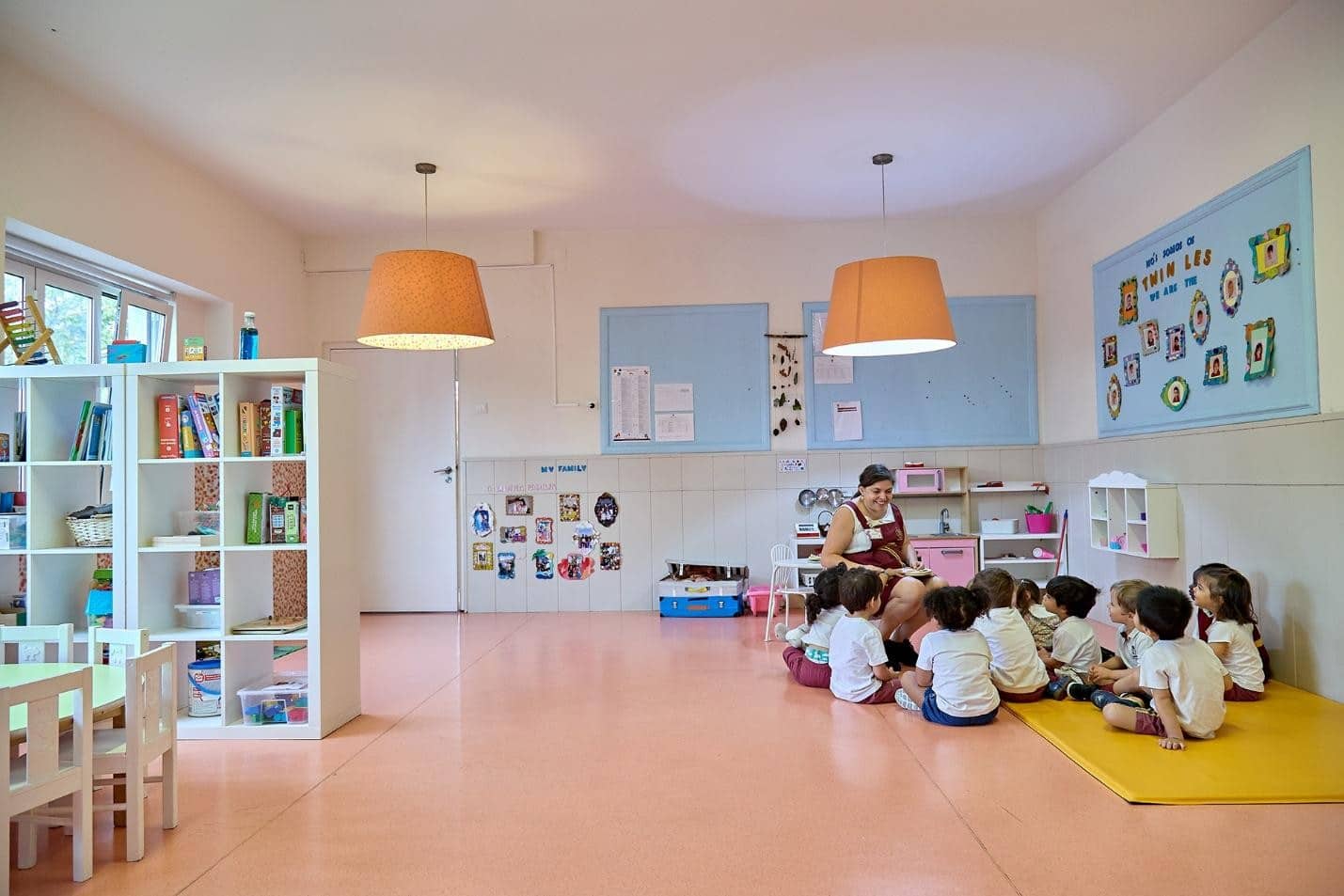
In Astoria’s Nursery, babies are surrounded by a sound environment rich in Portuguese and English, in which the educators communicate, sing and interact with the children in both languages naturally and consistently.
What develops at this stage is the foundation of all future acquisition:
- Prosody and melody: the baby’s brain registers the musicality of English and Portuguese as distinct sound patterns, creating the basis for future language differentiation.
- Rhythm and intonation: before understanding words, the child internalises the “sound” of each language — the way it rises and falls, speeds up and slows down.
- Early cognitive control: simultaneous exposure to two languages requires the baby’s brain to switch constantly between two linguistic systems, which stimulates the development of attention and executive control from the very first months of life.
2. Daycare and Kindergarten (2–6 years)
In Daycare and Kindergarten, the child begins to build an active vocabulary through everyday routines. Mealtimes, rest time and arts-and-crafts activities, for example, all become vehicles for language.
Here is what develops at this stage:
- Active vocabulary in Portuguese and English, acquired in real contexts through daily routines.
- Songs and rhymes, which link words to melodies and reinforce phonetic patterns in a natural and lasting way.
- Spontaneous language selection depending on the speaker, which signals that the linguistic systems are organising themselves in a healthy and independent way.
3. Primary School (6 to 10 years)
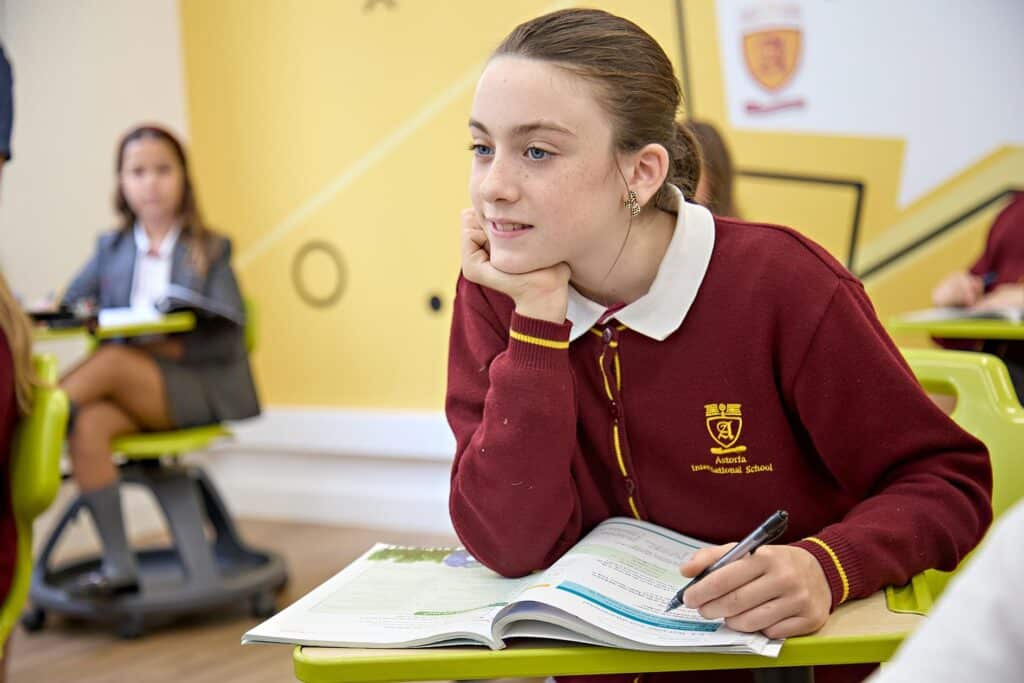
With the start of Primary School, language learning takes on a formal dimension and the model evolves within the cycle itself.
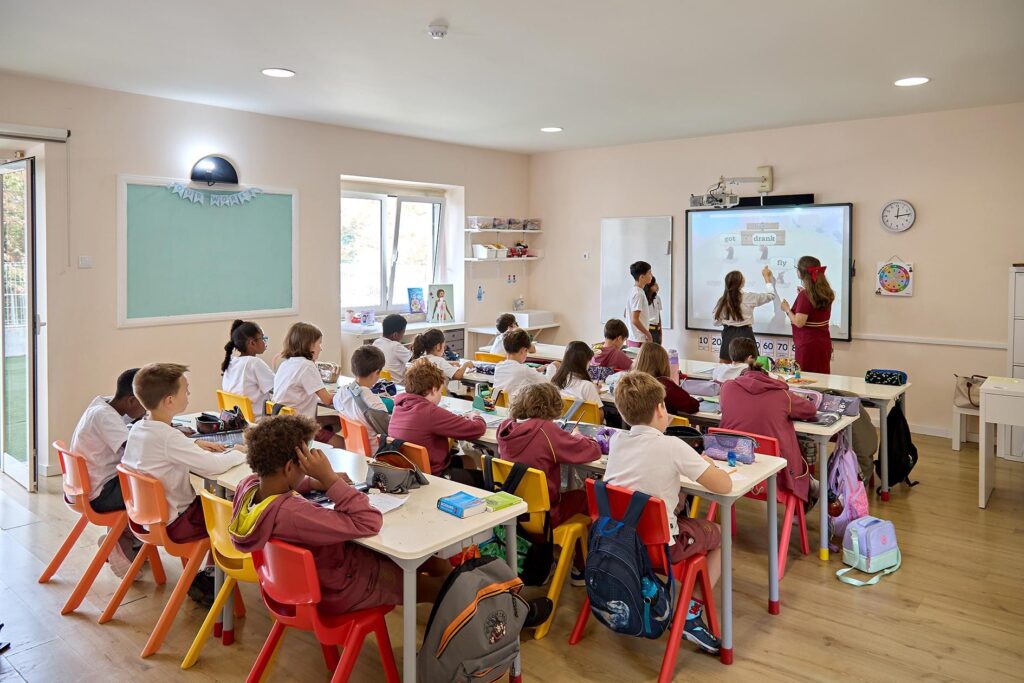
- 1st and 2nd years – bilingual (PT/EN): consolidation of literacy in Portuguese and English, with the development of reading, writing and oral skills in both languages, and preparation for international certifications such as Cambridge English and Trinity College London.
- 3rd and 4th years – trilingual (PT/EN/DE): German is introduced, with thematic vocabulary, everyday expressions and progressive communicative activities.
4. Middle School (10 to 15 years)
In the more advanced cycles, multilingual learning gains depth and formal recognition.
- German and French with growing academic rigour, worked on in demanding subject-based and communicative contexts.
- International certifications that validate the language journey in global academic and professional contexts.
- Interdisciplinary projects in multiple languages, in which the natural switching between languages is visible and valued.
- Consolidated cognitive flexibility, the result of years of multilingual education, proving to be a real and measurable academic advantage in preparation for Secondary and Higher Education.
How daily life is organised in a multilingual school
Managing four languages within a single school requires careful organisation, and it is precisely in that organisation that much of the value of Astoria’s model lies:
- Language rotation: throughout the day, children move naturally between languages depending on the activity and the teacher. This transition is not abrupt, but contextualised. The child learns to associate each language with a specific context, which reinforces organic acquisition.
- Native teachers: having teachers whose mother tongue is English, German or French is decisive for the quality of language exposure. A child who hears the language with authentic accent, intonation and structures receives a far richer linguistic input than a conventional foreign-language lesson can offer.
- Activities by language: drama, music, sport and the arts are each conducted in a specific language, creating an association between the language and a field of experience. This functional compartmentalisation helps the child’s brain to organise its linguistic systems efficiently.
Proven cognitive benefits
Scientific research consistently shows that growing up in multilingual environments transforms the way the brain organises and processes information.
A large-scale study [Kwon et al. (2021)], published in PNAS, involving more than 1,000 children, showed that multilingual children outperform monolingual children in verbal working-memory tasks and display distinct patterns of brain connectivity.
Among the best-documented benefits are the following:
- Greater ease in switching between tasks (task-switching);
- Earlier development of social perspective-taking;
- Cross-cutting advantages in Mathematics, Science and fields that require abstract reasoning.
The cognitive benefits of multilingualism are just one dimension of a broader impact. If you would like to understand how an international education shapes more resilient, empathetic children who are ready for the world, read our article on the academic and social-emotional advantages of an international education.
The real difference between four integrated languages and teaching languages as an extracurricular subject
There is a fundamental distinction that parents should understand before comparing options: learning a language as a subject is radically different from learning through one.
In an extracurricular or isolated-subject model, the child learns grammar rules, vocabulary lists and sentence structures, and may memorise without being able to communicate fluently. The language is an object of study, something external to real experience.
In a curriculum-integration model like Astoria’s, the language is the medium through which the child lives their school experience. They do not learn “how to say ‘apple’ in English”. They ask for the apple in English, describe it in English and sing about it in English. Acquisition happens in context, with real communicative intent, and is therefore far more lasting and functional.
It is the difference between knowing a language and using it, and it is this difference that, in the years that follow, translates into international certifications earned with ease, into travel where language is not an obstacle, and into applications to international universities where the multilingual profile is genuine and not merely declared on a CV.
How to support language progress at home, even without speaking every language
One of parents’ most common concerns is this: “What if I don’t speak German? How can I keep up with what my child is learning?” The answer is more reassuring than it seems.
Supporting language at home does not require proficiency in the language, but curiosity, involvement and a few simple strategies:
- Ask your child to teach you: when they come home and say “the teacher taught us a song in French”, ask to hear it. The child consolidates what they learned by teaching it, and the adult shows that they value that knowledge.
- Use the resources the school provides: Astoria offers support materials and keeps close communication with families about each pupil’s language journey.
- Don’t correct language mixing at home: if your child uses an English word in the middle of a Portuguese sentence, don’t reprimand them. Smile, repeat the word correctly in context, and let the process unfold.
- Celebrate the milestones: the first time the child counts to ten in German or sings a song in French is a moment to celebrate, even if they don’t understand every word.
A decision that begins long before the first lesson
Multilingual education in Lisbon is now an accessible reality, but not all approaches are the same.
The difference between exposing a child to languages and genuinely integrating them into their developmental journey is the difference between a curriculum and a life experience.
What the science confirms — and what daily life at Astoria International School demonstrates — is that four languages are not too many for a child. When introduced with progression, intentionality and affection, they are exactly what the developing brain is looking for: stimulation, context and purpose.
The window is open. The question is not whether your child is capable, but whether they have the opportunity.
Book a visit to Astoria and see, first-hand, how four languages fit into a single school day.
Frequently Asked Questions (FAQ)
1. At what age is each language introduced at Astoria?
English and Portuguese are present from the Nursery (4 months), forming the bilingual foundation of the journey. German is introduced in the 3rd and 4th years of Primary School, making the model trilingual. French is added from the 5th year, completing the four-integrated-language curriculum that is consolidated throughout Middle School.
2. My child is 8 years old and has never been to a multilingual school. Is it too late?
No. Although the window of greatest neurological plasticity is in the first seven years, the brain retains the capacity for language learning throughout life. Astoria carries out an individual assessment of each pupil on entry, regardless of age.
3. Does Astoria offer international certifications to validate pupils' language levels?
Yes. The school works with recognised certifications such as Cambridge English and Trinity College London, which independently assess pupils’ English skills, providing external validation of the multilingual journey.
4. What are the foreign-language teachers like?
Astoria has native foreign-language teachers, which ensures authentic language exposure, with the real accents, intonation and structures of each language.
5. Is it possible to enrol a child mid-way through the school year?
Yes. New pupils can be enrolled throughout the school year, in accordance with current legislation. After completing the enrolment form, the school schedules a visit with the Psychology and Guidance Department, during which the educational project and admission conditions are presented to the family.