
Choosing an international school in Lisbon involves more than just comparing prices: you need to assess the curriculum, languages, teaching methods and practical arrangements. This guide brings together the criteria that really matter and a checklist to ensure you don’t leave any school visit empty-handed.
The capital, Lisbon, has been attracting thousands of families from all over the world, which explains the exponential growth in demand for international schools in Lisbon.
Whether you are exploring alternatives to state education, considering a private school in Lisbon with an international focus, or simply comparing options for the coming academic year, this guide has been written for you.
Throughout the following sections, you will find objective criteria, specific questions and useful references, including what leads so many Portuguese and expat families to place their trust in Astoria International School year after year.
What is the difference between an international, bilingual or national private school?
The labels can be confusing. Here is a brief description of each:
- International school: typically follows a globally recognised curriculum, such as the Cambridge curriculum, and welcomes pupils of various nationalities;
- Bilingual school: may follow the Portuguese national curriculum, but delivers a significant proportion of its lessons in another language, usually English;
- National private school: with no international component, it adheres fully to the Portuguese Ministry of Education’s programme, distinguishing itself primarily through class sizes, teaching resources and individualised attention.
Astoria International School sits precisely at this crossroads: it is a private school in Lisbon with an international DNA, where the academic curriculum coexists with a progressive model of bilingual and multilingual education, serving both Portuguese families who wish to prepare their children for a globalised world and expatriate families seeking academic continuity and cultural integration in the city they have chosen to live in.
Objective criteria for choosing the right school
Visiting schools is easy, but knowing what to look for and what to ask is difficult.
Before booking any visit, it is worth being clear about the criteria that really matter to your family and learning to distinguish what is essential from what is merely a marketing ploy.
1. Curriculum
Before visiting any school, identify the most suitable academic pathway for your child and check whether the school in question recognises prior learning, particularly if you are moving.
2. Location and transport in Lisbon
Lisbon is a compact city, but traffic can disrupt the start of the day.
Opt for schools that are easily accessible from where you live, whether on foot, by public transport or via a school transport service.
An excellent school that involves a daily 45-minute drive can become a source of unnecessary stress for the whole family.
3. Class sizes
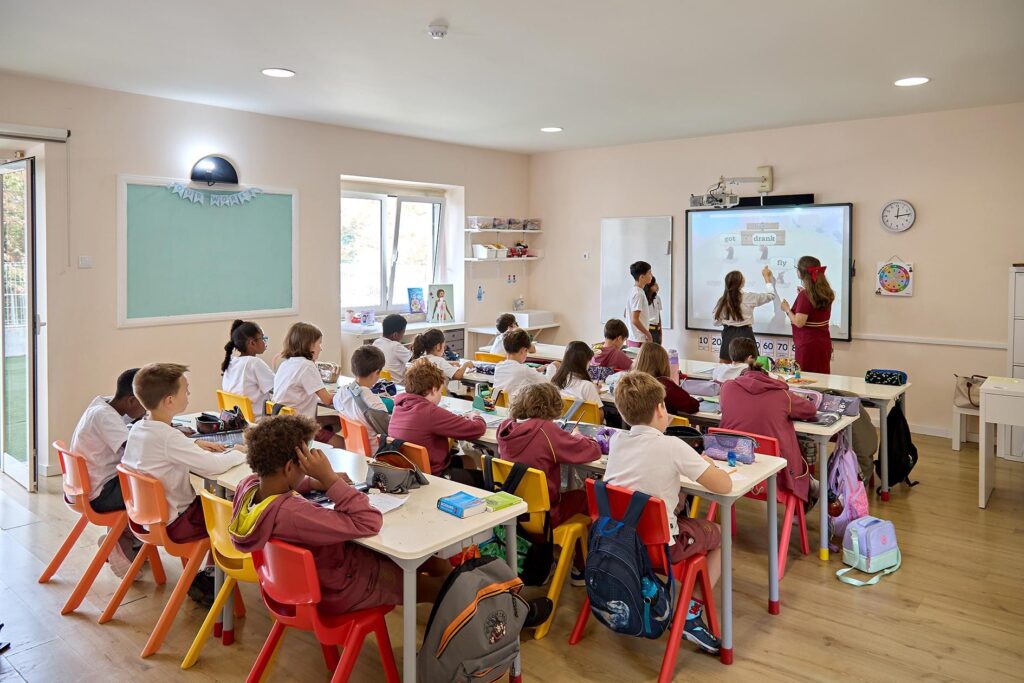
Smaller classes allow for closer supervision. Schools with fewer than 20 pupils per class tend to see greater teacher involvement and a better response to each child’s individual needs.
4. Pedagogy and child development
Ask how the school approaches active learning, socio-emotional development and pupils’ autonomy.
Methodologies such as the Modern School Movement (MEM) or Howard Gardner’s theory of multiple intelligences focus on child-centred education, which is very different from a traditional, teacher-centred model.
5. Extracurricular activities, languages and support services
What is offered beyond the classroom is revealing.
Check for a diverse range of extracurricular activities, psychological support, a catering service and extended hours.
The integration of additional languages from an early age also represents a considerable advantage in today’s globalised world.
Calendar and enrolment process in Portugal
The school year in Portugal generally begins in September and ends in June.
Enrolment at private and international schools often opens between January and March for the following year, and places fill up quickly, particularly in the early years.
If you are planning a move for the 2026/2027 academic year, do not delay the application process. Most schools require the student’s documentation, an application form, possibly a meeting with the management, and sometimes a prior visit to the premises.
At Astoria, you can request information directly online, with no obligation. Additionally, you can consult the Astoria school calendar for a clear reference.
What relocating families should consider
For expatriate families, continuity of the curriculum is a priority.
If your child has studied in a British system, for example, check whether the school of choice ensures equivalence and recognition of qualifications.
Also check whether there is support for language integration, such as classes in Portuguese as a non-native language, for example, and whether the school community is sufficiently multicultural to facilitate the child’s social adaptation.
It is precisely at this point that external recognition can be informative.
Astoria is one of the schools awarded the Intercultural School Seal, granted by the Directorate-General for Education (DGE), the High Commission for Migration and the Aga Khan Foundation Portugal, a distinction awarded to schools that excel in valuing cultural diversity as an active part of the educational process, rather than merely a decorative backdrop.
Checklist for visiting a school
Before making a decision, visit the school in person and ask the following questions:
- What is the language model adopted and in which years are new languages introduced?
- How many pupils are there in each class?
- How is communication between the school and the family carried out?
- Are there support mechanisms for children with special needs?
- What is the assessment policy and how is the transition between school stages managed?
- Are the indoor and outdoor facilities suitable for the different age groups?
- What international accreditations and partnerships does the school have?
The answers to these questions reveal more about a school than any brochure. If a visit does not provide sufficient clarity, it is a sign that you should arrange another one.
When Astoria makes sense
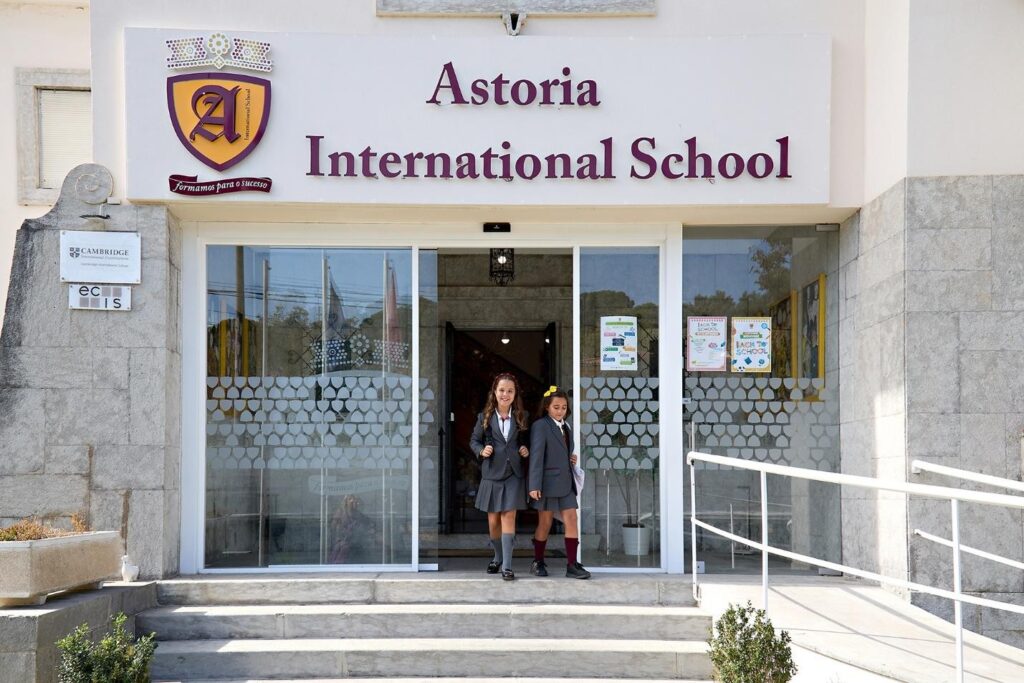
Astoria International School is an excellent choice for families looking for an international school in Lisbon offering a continuous pathway from Nursery to Year 12, and who value small class sizes, a family atmosphere and a structured approach to language learning.
Astoria’s model is based on English-Portuguese bilingualism in the early years, introduces German in Years 3 and 4, and adds French from Year 5 onwards, preparing pupils for international academic and professional contexts.
The methodology is inspired by the MEM and the theory of multiple intelligences, which translates into an approach centred on each child’s individual talents and learning pace.
The central location on Avenida Almirante Gago Coutinho is a real logistical advantage for those living in the heart of Lisbon.
Finally, the Cambridge and Trinity certifications, as well as participation in the Eco-Schools and Saudavelmente programmes, are objective indicators of quality and commitment to the holistic development of pupils.
If you would like to find out more about our educational project, book a visit or attend one of the Open Days to get a feel for the environment before making a decision.
Frequently Asked Questions (FAQ)
1. Do international schools in Lisbon accept children who do not speak English?
Most schools offering bilingual or international education have language support mechanisms in place for children who arrive without proficiency in the language of instruction. Always check with the school regarding the integration programme available.
2. Is it possible to change schools in Lisbon mid-term?
Yes, although the transition is simpler at the start of the year. In private schools, the process depends on the availability of places and an assessment of the pupil’s profile.
3. Is the Portuguese curriculum recognised internationally?
The Portuguese national curriculum is recognised in several countries, but not universally. For access to universities outside Portugal or for families who move frequently, an international curriculum offers greater portability.
4. What is the difference between a private school and a bilingual school in Portugal?
A private school follows the national curriculum, with some extra English tuition. A bilingual school, on the other hand, delivers a significant part of the curriculum in a foreign language, aiming for functional language acquisition from an early age.
5. Do private schools in Lisbon offer support to expatriate families?
Many do, particularly those with an established multicultural community. Check for integration support services, Portuguese as a second language classes and networks of international families.